Low level function for high-quality triangulations
inla.mesh.create.Rd![[Deprecated]](figures/lifecycle-deprecated.svg) since
since 23.08.18
in favour of fmesher::fm_rcdt_2d_inla().
Create a constrained refined Delaunay triangulation (CRDT) for a set of spatial locations.
inla.mesh.create generates triangular meshes on subsets of
\(R^2\) and \(S^2\). Use the higher level wrapper function
inla.mesh.2d() for greater control over mesh resolution and
coarser domain extensions.
inla.delaunay is a wrapper function for obtaining the convex hull of
a point set and calling inla.mesh.create to generate the classical
Delaunay tringulation.
inla.mesh.create(
  loc = NULL,
  tv = NULL,
  boundary = NULL,
  interior = NULL,
  extend = (missing(tv) || is.null(tv)),
  refine = FALSE,
  lattice = NULL,
  globe = NULL,
  cutoff = 1e-12,
  plot.delay = NULL,
  data.dir = NULL,
  keep = (!missing(data.dir) && !is.null(data.dir)),
  timings = FALSE,
  quality.spec = NULL,
  crs = NULL
)

inla.delaunay(loc, ...)
Arguments
- loc
Matrix of point locations. Can alternatively be a
SpatialPointsorSpatialPointsDataFrameobject.- tv
A triangle-vertex index matrix, specifying an existing triangulation.
- boundary
A list of
inla.mesh.segmentobjects, generated byinla.mesh.segment(), specifying boundary constraint segments.- interior
A list of
inla.mesh.segmentobjects, generated byinla.mesh.segment(), specifying interior constraint segments.- extend
logicalorlistspecifying whether to extend the data region, with parameters- list("n")
the number of edges in the extended boundary (default=8)
- list("offset")
the extension distance. If negative, interpreted as a factor relative to the approximate data diameter (default=-0.10)
Setting to
FALSEis only useful in combinationlatticeorboundary.- refine
logicalorlistspecifying whether to refine the triangulation, with parameters- list("min.angle")
the minimum allowed interior angle in any triangle. The algorithm is guaranteed to converge for
min.angleat most 21 (default=21)- list("max.edge")
the maximum allowed edge length in any triangle. If negative, interpreted as a relative factor in an ad hoc formula depending on the data density (default=
Inf)- list("max.n.strict")
the maximum number of vertices allowed, overriding
min.angleandmax.edge(default=-1, meaning no limit)- list("max.n")
the maximum number of vertices allowed, overriding
max.edgeonly (default=-1, meaning no limit)
- lattice
An
inla.mesh.latticeobject, generated byinla.mesh.lattice(), specifying points on a regular lattice.- globe
Subdivision resolution for a semi-regular spherical triangulation with equidistant points along equidistant latitude bands.
- cutoff
The minimum allowed distance between points. Point at most as far apart as this are replaced by a single vertex prior to the mesh refinement step.
- plot.delay
On Linux (and Mac if appropriate X11 libraries are installed), specifying a numeric value activates a rudimentary plotting system in the underlying
fmesherprogram, showing the triangulation algorithm at work.- data.dir
Where to store the
fmesherdata files. Defaults totempdir()ifkeepisFALSE, otherwise"inla.mesh.data".- keep
TRUEif the data files should be kept indata.diror deleted afterwards. Defaults to true ifdata.diris specified, otherwise false. Warning: Ifkeepis false,data.dirand its contents will be deleted (unless set totempdir()).- timings
If
TRUE, obtain timings for the mesh construction.- quality.spec
List of vectors of per vertex
max.edgetarget specification for each location inloc,boundary/interior(segm), andlattice. Only used if refining the mesh.- crs
An optional
CRSorinla.CRSobject- ...
Optional parameters passed on to
inla.mesh.create.
Value
An inla.mesh object.
Functions
inla.delaunay(): since 23.08.18. Usefmesher::fm_delaunay_2d()instead.
See also
Examples
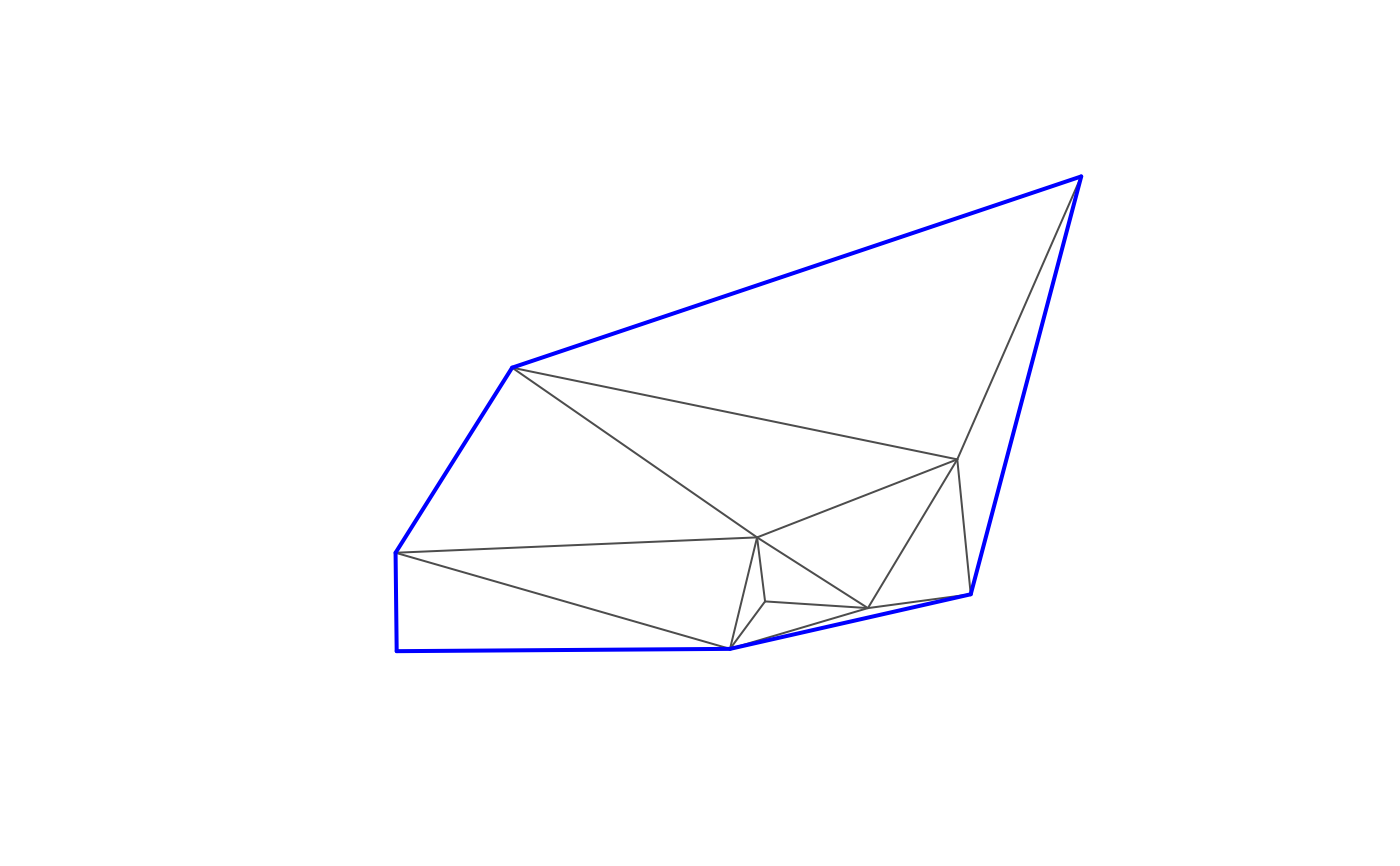
loc <- matrix(runif(10 * 2), 10, 2)
mesh <- inla.delaunay(loc)
#> Warning: `inla.delaunay()` was deprecated in INLA 23.08.18.
#> ℹ Please use `fmesher::fm_delaunay_2d()` instead.
#> ℹ For more information, see
#> https://inlabru-org.github.io/fmesher/articles/inla_conversion.html
#> ℹ To silence these deprecation messages in old legacy code, set
#> `inla.setOption(fmesher.evolution.warn = FALSE)`.
#> ℹ To ensure visibility of these messages in package tests, also set
#> `inla.setOption(fmesher.evolution.verbosity = 'warn')`.
plot(mesh)
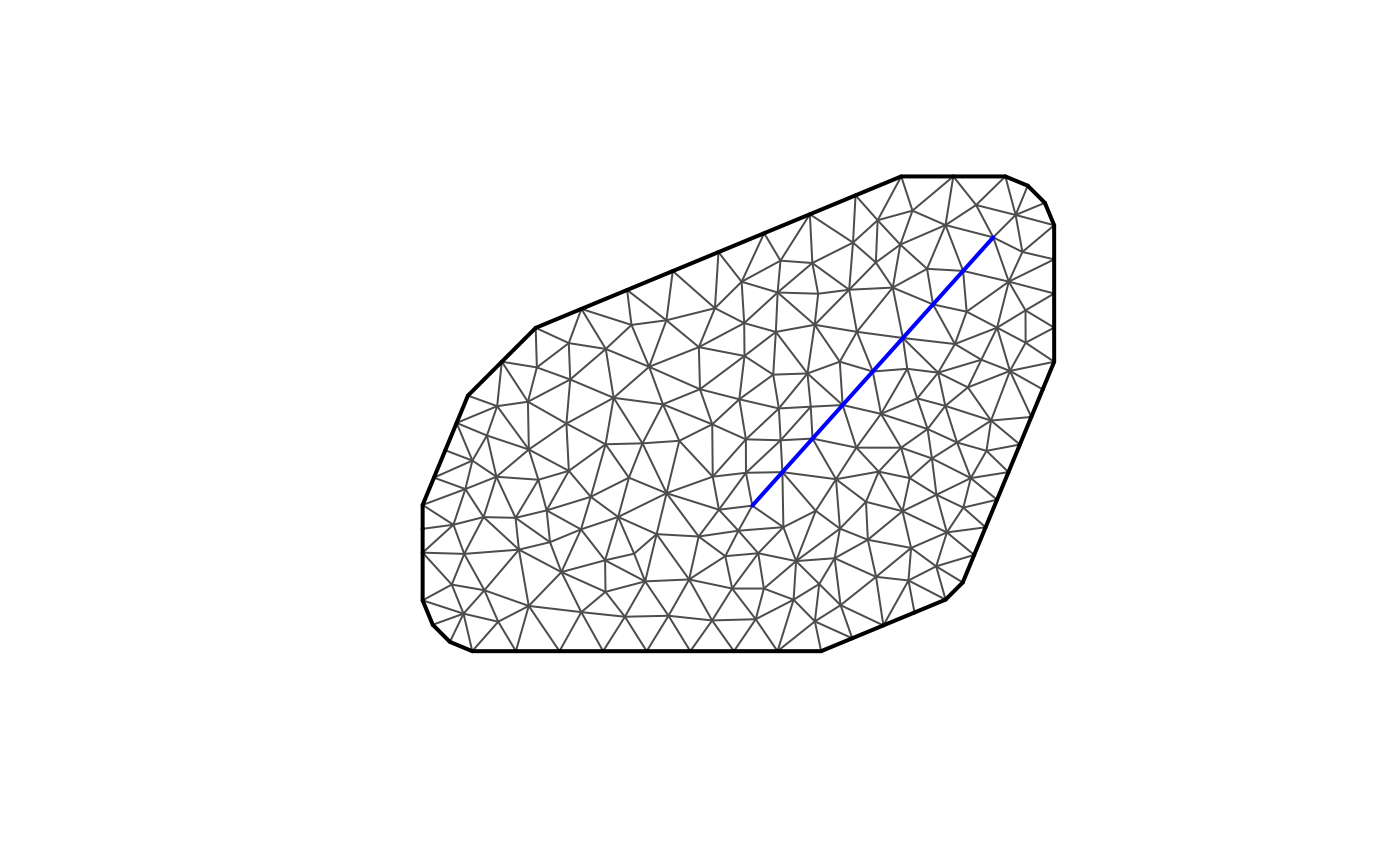
 mesh <- inla.mesh.create(loc,
interior = inla.mesh.segment(idx = 1:2),
extend = TRUE,
refine = list(max.edge = 0.1)
)
#> Warning: `inla.mesh.create()` was deprecated in INLA 23.08.18.
#> ℹ Please use `fmesher::fm_rcdt_2d_inla()` instead.
#> ℹ For more information, see
#> https://inlabru-org.github.io/fmesher/articles/inla_conversion.html
#> ℹ To silence these deprecation messages in old legacy code, set
#> `inla.setOption(fmesher.evolution.warn = FALSE)`.
#> ℹ To ensure visibility of these messages in package tests, also set
#> `inla.setOption(fmesher.evolution.verbosity = 'warn')`.
#> Warning: `inla.mesh.segment()` was deprecated in INLA 23.08.18.
#> ℹ Please use `fmesher::fm_segm()` instead.
#> ℹ For more information, see
#> https://inlabru-org.github.io/fmesher/articles/inla_conversion.html
#> ℹ To silence these deprecation messages in old legacy code, set
#> `inla.setOption(fmesher.evolution.warn = FALSE)`.
#> ℹ To ensure visibility of these messages in package tests, also set
#> `inla.setOption(fmesher.evolution.verbosity = 'warn')`.
plot(mesh)
mesh <- inla.mesh.create(loc,
interior = inla.mesh.segment(idx = 1:2),
extend = TRUE,
refine = list(max.edge = 0.1)
)
#> Warning: `inla.mesh.create()` was deprecated in INLA 23.08.18.
#> ℹ Please use `fmesher::fm_rcdt_2d_inla()` instead.
#> ℹ For more information, see
#> https://inlabru-org.github.io/fmesher/articles/inla_conversion.html
#> ℹ To silence these deprecation messages in old legacy code, set
#> `inla.setOption(fmesher.evolution.warn = FALSE)`.
#> ℹ To ensure visibility of these messages in package tests, also set
#> `inla.setOption(fmesher.evolution.verbosity = 'warn')`.
#> Warning: `inla.mesh.segment()` was deprecated in INLA 23.08.18.
#> ℹ Please use `fmesher::fm_segm()` instead.
#> ℹ For more information, see
#> https://inlabru-org.github.io/fmesher/articles/inla_conversion.html
#> ℹ To silence these deprecation messages in old legacy code, set
#> `inla.setOption(fmesher.evolution.warn = FALSE)`.
#> ℹ To ensure visibility of these messages in package tests, also set
#> `inla.setOption(fmesher.evolution.verbosity = 'warn')`.
plot(mesh)
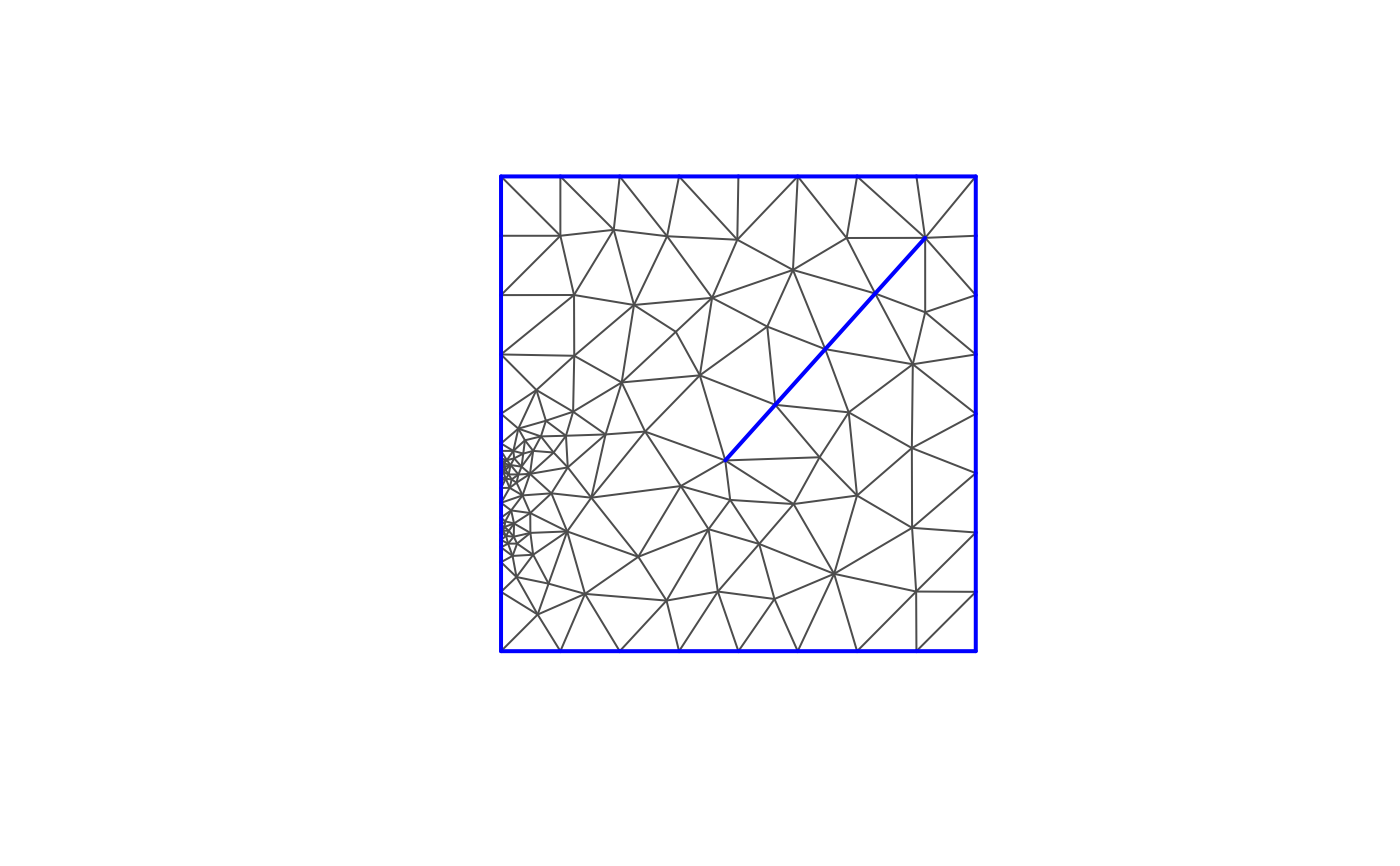
 loc2 <- matrix(c(0, 1, 1, 0, 0, 0, 1, 1), 4, 2)
mesh2 <- inla.mesh.create(
loc = loc,
boundary = inla.mesh.segment(loc2),
interior = inla.mesh.segment(idx = 1:2),
quality.spec = list(segm = 0.2, loc = 0.05),
refine = list(min.angle = 26)
)
plot(mesh2)
loc2 <- matrix(c(0, 1, 1, 0, 0, 0, 1, 1), 4, 2)
mesh2 <- inla.mesh.create(
loc = loc,
boundary = inla.mesh.segment(loc2),
interior = inla.mesh.segment(idx = 1:2),
quality.spec = list(segm = 0.2, loc = 0.05),
refine = list(min.angle = 26)
)
plot(mesh2)