High-quality triangulations
inla.mesh.2d.Rd![[Deprecated]](figures/lifecycle-deprecated.svg) since
since 23.08.18.
Use fmesher::fm_mesh_2d_inla() instead.
Create a triangle mesh based on initial point locations, specified or automatic boundaries, and mesh quality parameters.
inla.mesh.2d(
  loc = NULL,
  loc.domain = NULL,
  offset = NULL,
  n = NULL,
  boundary = NULL,
  interior = NULL,
  max.edge = NULL,
  min.angle = NULL,
  cutoff = 1e-12,
  max.n.strict = NULL,
  max.n = NULL,
  plot.delay = NULL,
  crs = NULL
)
Arguments
- loc
Matrix of point locations to be used as initial triangulation nodes. Can alternatively be a
SpatialPointsorSpatialPointsDataFrameobject.- loc.domain
Matrix of point locations used to determine the domain extent. Can alternatively be a
SpatialPointsorSpatialPointsDataFrameobject.- offset
The automatic extension distance. One or two values, for an inner and an optional outer extension. If negative, interpreted as a factor relative to the approximate data diameter (default=-0.10???)
- n
The number of initial nodes in the automatic extensions (default=16)
- boundary
A list of one or two
inla.mesh.segment()objects describing domain boundaries.- interior
An
inla.mesh.segment()object describing desired interior edges.- max.edge
The largest allowed triangle edge length. One or two values.
- min.angle
The smallest allowed triangle angle. One or two values. (Default=21)
- cutoff
The minimum allowed distance between points. Point at most as far apart as this are replaced by a single vertex prior to the mesh refinement step.
- max.n.strict
The maximum number of vertices allowed, overriding
min.angleandmax.edge(default=-1, meaning no limit). One or two values, where the second value gives the number of additional vertices allowed for the extension.- max.n
The maximum number of vertices allowed, overriding
max.edgeonly (default=-1, meaning no limit). One or two values, where the second value gives the number of additional vertices allowed for the extension.- plot.delay
On Linux (and Mac if appropriate X11 libraries are installed), specifying a nonnegative numeric value activates a rudimentary plotting system in the underlying
fmesherprogram, showing the triangulation algorithm at work, with waiting time factorplot.delaybetween each step.On all systems, specifying any negative value activates displaying the result after each step of the multi-step domain extension algorithm.
- crs
An optional
CRSorinla.CRSobject
Value
An inla.mesh object.
Examples
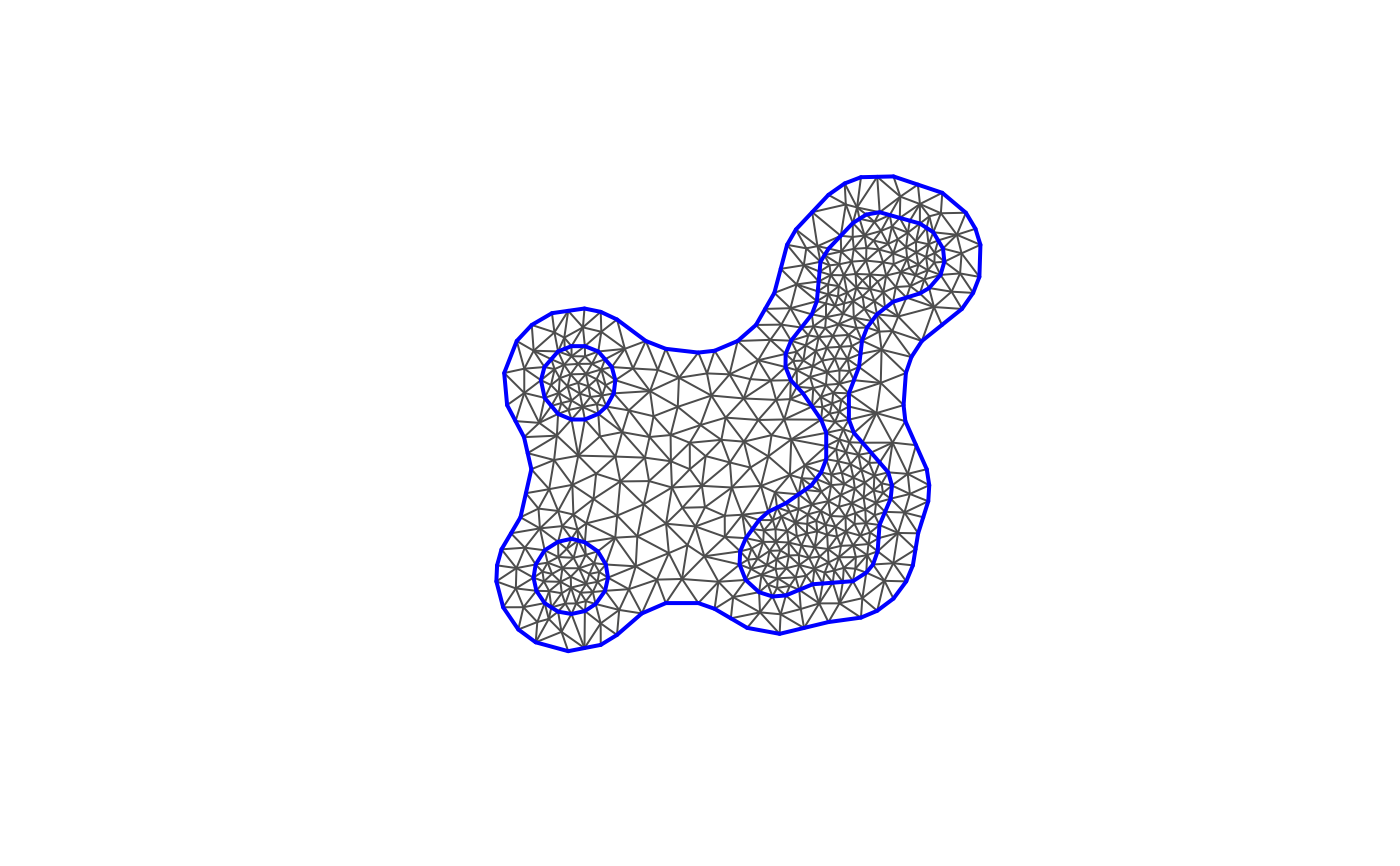
loc <- matrix(runif(10 * 2), 10, 2)

if (require("splancs")) {
  boundary <- list(
    inla.nonconvex.hull(loc, 0.1, 0.15),
    inla.nonconvex.hull(loc, 0.2, 0.2)
  )
  offset <- NULL
} else {
  boundary <- NULL
  offset <- c(0.1, 0.2)
}
#> Loading required package: splancs
#>
#> Spatial Point Pattern Analysis Code in S-Plus
#>
#>  Version 2 - Spatial and Space-Time analysis
#> Warning: `inla.nonconvex.hull()` was deprecated in INLA 23.08.18.
#> ℹ Please use `fmesher::fm_nonconvex_hull()` instead.
#> ℹ For more information, see
#>   https://inlabru-org.github.io/fmesher/articles/inla_conversion.html
#> ℹ To silence these deprecation messages in old legacy code, set
#>   `inla.setOption(fmesher.evolution.warn = FALSE)`.
#> ℹ To ensure visibility of these messages in package tests, also set
#>   `inla.setOption(fmesher.evolution.verbosity = 'warn')`.
mesh <- inla.mesh.2d(loc, boundary = boundary, offset = offset, max.edge = c(0.05, 0.1))
#> Warning: `inla.mesh.2d()` was deprecated in INLA 23.08.18.
#> ℹ Please use `fmesher::fm_mesh_2d_inla()` instead.
#> ℹ For more information, see
#>   https://inlabru-org.github.io/fmesher/articles/inla_conversion.html
#> ℹ To silence these deprecation messages in old legacy code, set
#>   `inla.setOption(fmesher.evolution.warn = FALSE)`.
#> ℹ To ensure visibility of these messages in package tests, also set
#>   `inla.setOption(fmesher.evolution.verbosity = 'warn')`.

plot(mesh)