Basis functions for inla.mesh
inla.mesh.basis.Rd![[Deprecated]](figures/lifecycle-deprecated.svg) since
since 23.08.18.
Use fmesher::fm_raw_basis() instead.
Calculate basis functions on a 1d or 2d inla.mesh()
inla.mesh.basis(
  mesh,
  type = "b.spline",
  n = 3,
  degree = 2,
  knot.placement = "uniform.area",
  rot.inv = TRUE,
  boundary = "free",
  free.clamped = TRUE,
  ...
)
Arguments
- mesh
An
inla.mesh.1dorinla.meshobject.- type
b.spline(default) for B-spline basis functions,sph.harmfor spherical harmonics (available only for meshes on the sphere)- n
For B-splines, the number of basis functions in each direction (for 1d meshes
nmust be a scalar, and for planar 2d meshes a 2-vector). For spherical harmonics,nis the maximal harmonic order.- degree
Degree of B-spline polynomials. See
inla.mesh.1d().- knot.placement
For B-splines on the sphere, controls the latitudinal placements of knots.
"uniform.area"(default) gives uniform spacing insin(latitude),"uniform.latitude"gives uniform spacing in latitudes.- rot.inv
For spherical harmonics on a sphere,
rot.inv=TRUEgives the rotationally invariant subset of basis functions.- boundary
Boundary specification, default is free boundaries. See
inla.mesh.1d()for more information.- free.clamped
If
TRUEandboundaryis"free", the boundary basis functions are clamped to 0/1 at the interval boundary by repeating the boundary knots.- ...
Unused
See also
Examples
n <- 100
loc <- matrix(runif(n * 2), n, 2)
mesh <- inla.mesh.2d(loc, max.edge = 0.05)
basis <- inla.mesh.basis(mesh, n = c(4, 5))
#> Warning: `inla.mesh.basis()` was deprecated in INLA 23.08.18.
#> ℹ Please use `fmesher::fm_raw_basis()` instead.
#> ℹ For more information, see
#> https://inlabru-org.github.io/fmesher/articles/inla_conversion.html
#> ℹ To silence these deprecation messages in old legacy code, set
#> `inla.setOption(fmesher.evolution.warn = FALSE)`.
#> ℹ To ensure visibility of these messages in package tests, also set
#> `inla.setOption(fmesher.evolution.verbosity = 'warn')`.
proj <- inla.mesh.projector(mesh)
#> Warning: `inla.mesh.projector()` was deprecated in INLA 23.06.07.
#> ℹ Please use `fmesher::fm_evaluator()` instead.
#> ℹ For more information, see
#> https://inlabru-org.github.io/fmesher/articles/inla_conversion.html
#> ℹ To silence these deprecation messages in old legacy code, set
#> `inla.setOption(fmesher.evolution.warn = FALSE)`.
#> ℹ To ensure visibility of these messages in package tests, also set
#> `inla.setOption(fmesher.evolution.verbosity = 'warn')`.
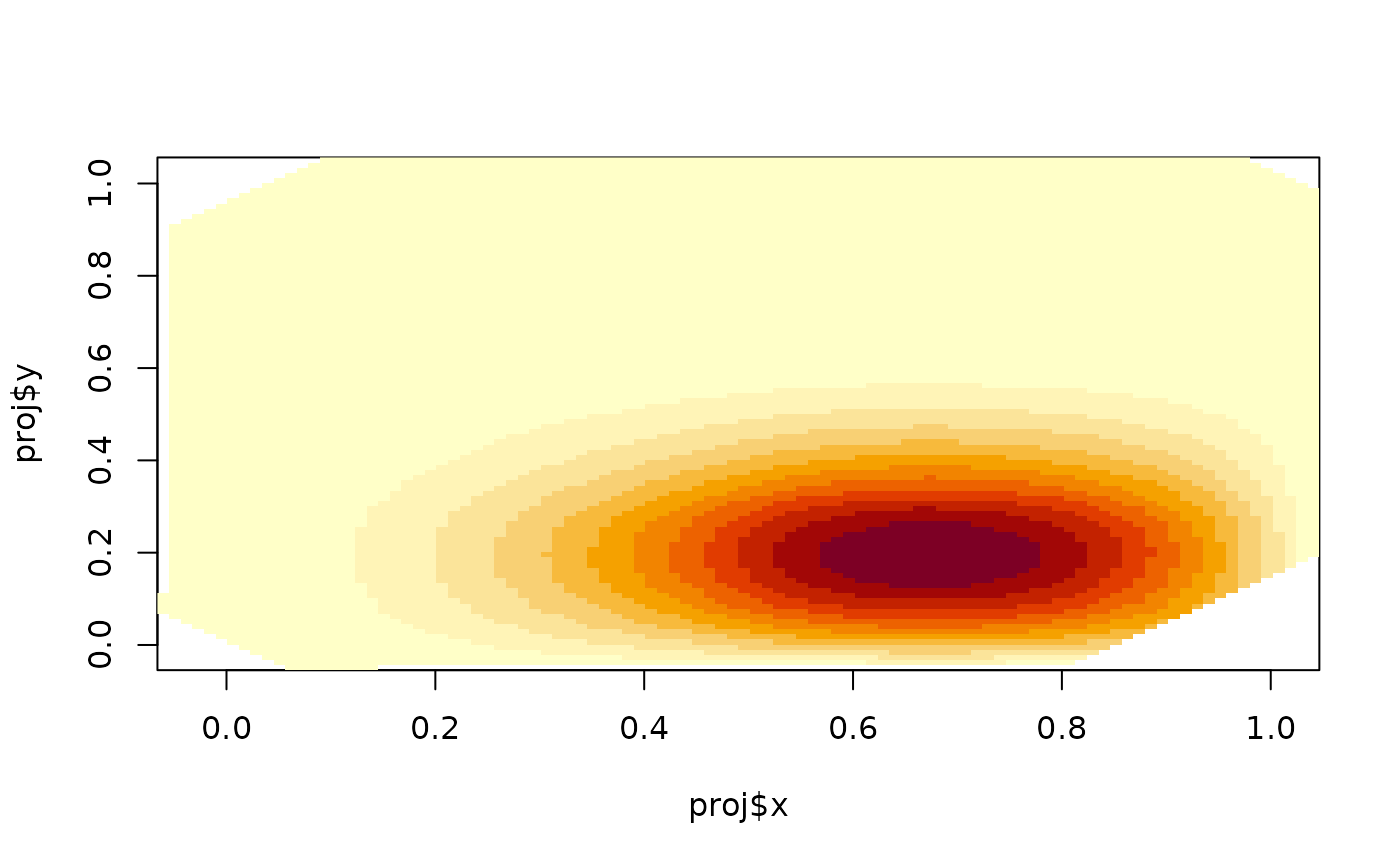
image(proj$x, proj$y, inla.mesh.project(proj, basis[, 7]))
#> Warning: `inla.mesh.project()` was deprecated in INLA 23.06.07.
#> ℹ Please use `fmesher::fm_evaluate()` instead.
#> ℹ For more information, see
#> https://inlabru-org.github.io/fmesher/articles/inla_conversion.html
#> ℹ To silence these deprecation messages in old legacy code, set
#> `inla.setOption(fmesher.evolution.warn = FALSE)`.
#> ℹ To ensure visibility of these messages in package tests, also set
#> `inla.setOption(fmesher.evolution.verbosity = 'warn')`.
 # \donttest{
if (require(rgl)) {
plot(mesh, rgl = TRUE, col = basis[, 7], draw.edges = FALSE, draw.vertices = FALSE)
}
#> Loading required package: rgl
#> Warning: RGL: unable to open X11 display
#> Warning: 'rgl.init' failed, will use the null device.
#> See '?rgl.useNULL' for ways to avoid this warning.
#> Error: The `rgl` argument of `plot.fm_mesh_2d()` was deprecated in fmesher
#> 0.1.0 and is now defunct.
#> ℹ Please use `plot_rgl()` instead.
# }
# \donttest{
if (require(rgl)) {
plot(mesh, rgl = TRUE, col = basis[, 7], draw.edges = FALSE, draw.vertices = FALSE)
}
#> Loading required package: rgl
#> Warning: RGL: unable to open X11 display
#> Warning: 'rgl.init' failed, will use the null device.
#> See '?rgl.useNULL' for ways to avoid this warning.
#> Error: The `rgl` argument of `plot.fm_mesh_2d()` was deprecated in fmesher
#> 0.1.0 and is now defunct.
#> ℹ Please use `plot_rgl()` instead.
# }