Construct a neighbour-matrix from a graph
graph.matrix.RdConstruct a neighbour-matrix from a graph and disaply it
inla.matrix2graph(graph, ...)

inla.graph2matrix(graph, ...)

inla.spy(graph, ..., reordering = NULL)
Arguments
- graph
An
inla.graph-object, a (sparse) symmetric matrix, a filename containing the graph, or a list or collection of characters and/or numbers defining the graph.- ...
Additional arguments to
inla.read.graph()- reordering
A possible reordering. Typical the one obtained from a
inla-call,result$misc$reordering, or the result ofinla.qreordering.
Value
inla.graph2matrix returns a sparse symmetric matrix where the
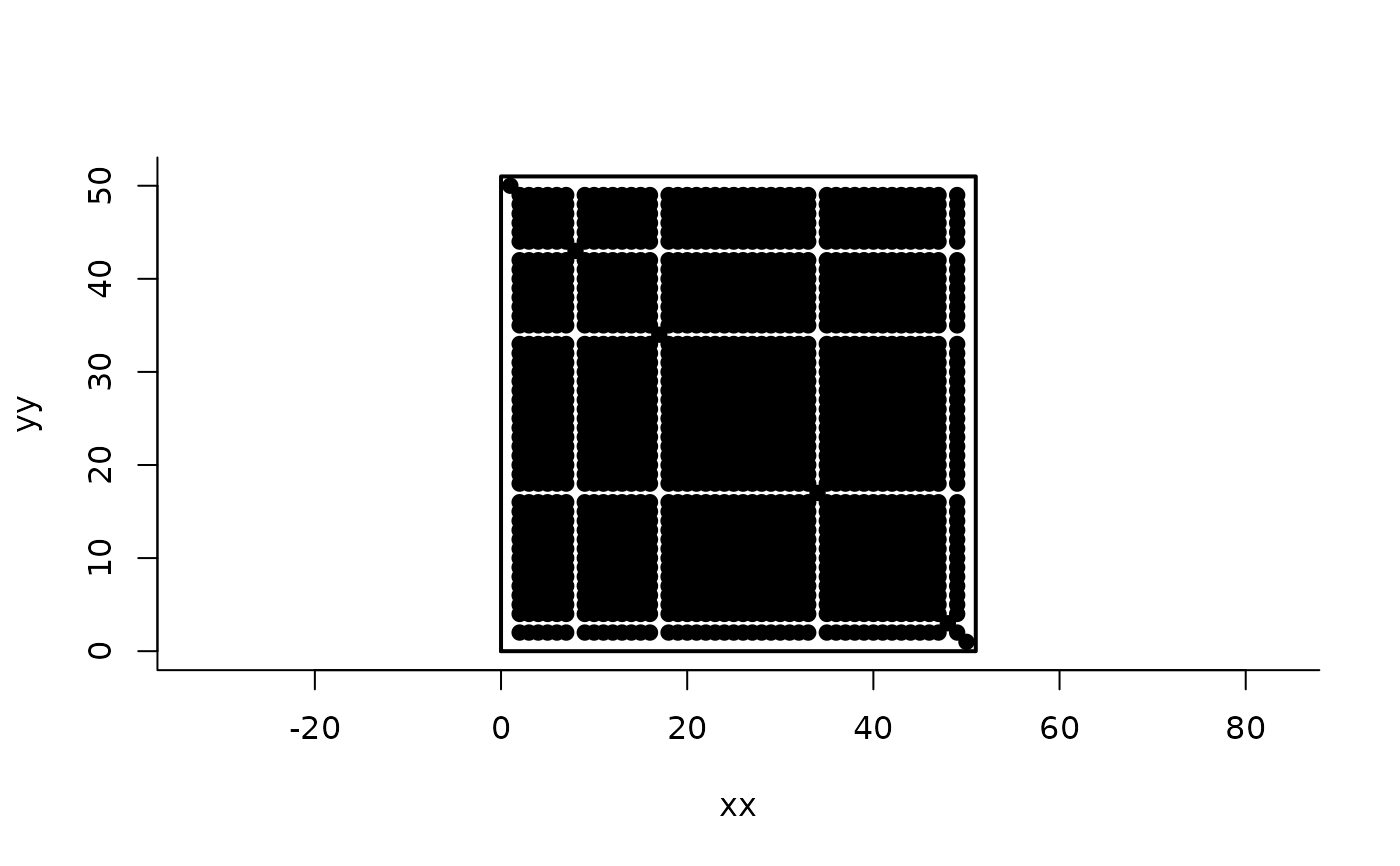
non-zero pattern is defined by the graph. The inla.spy
function, plots the associated sparse matrix defined by the graph. The reordering
argument is typically the reordering found by inla.qreordering().
See also
Examples
n = 50
Q = matrix(0, n, n)
idx = sample(1:n, 2*n, replace=TRUE)
Q[idx, idx] = 1
diag(Q) = 1
g = inla.read.graph(Q)
QQ = inla.graph2matrix(g)
inla.spy(QQ)
 print(all.equal(as.matrix(Q), as.matrix(QQ)))
#> [1] TRUE
g.file = inla.write.graph(g, filename = tempfile())
inla.dev.new()
inla.spy(g.file)
inla.spy(g.file, reordering = inla.qreordering(g))
g = inla.read.graph(g.file)
inla.dev.new()
inla.spy(g)
## Old examples that don't work with the inla.spy call syntax:
# inla.dev.new()
# inla.spy(3, 1, "1 2 2 1 1 3 0")
# inla.dev.new()
# inla.spy(3, 1, "1 2 2 1 1 3 0", reordering = 3:1)
print(all.equal(as.matrix(Q), as.matrix(QQ)))
#> [1] TRUE
g.file = inla.write.graph(g, filename = tempfile())
inla.dev.new()
inla.spy(g.file)
inla.spy(g.file, reordering = inla.qreordering(g))
g = inla.read.graph(g.file)
inla.dev.new()
inla.spy(g)
## Old examples that don't work with the inla.spy call syntax:
# inla.dev.new()
# inla.spy(3, 1, "1 2 2 1 1 3 0")
# inla.dev.new()
# inla.spy(3, 1, "1 2 2 1 1 3 0", reordering = 3:1)